
What comes before a wheelchair
The middle steps most people skip, and why going straight to a chair costs walking that could have been kept.
Families tend to think in two states: walking, and a wheelchair. The distance between those is several years wide and most of the useful equipment lives inside it. Skipping that ground is the single most common error in mobility adaptation, and it is expensive in a way that does not show up on a receipt.
The steps in between
- A better shoe and a clear floor. Unglamorous and genuinely the first step. A large share of instability is footwear, lighting and rugs.
- A single cane or offset cane. One point of contact. Good for mild balance trouble and mild single-sided weakness.
- Walking poles. Two points, distributes load across both sides, reads as outdoorsy rather than medical, and is frequently accepted when a cane is refused.
- A rollator. The workhorse. Brakes, storage, and a seat, which is what actually extends range: someone who can rest for ninety seconds every two hundred yards can go a very long way.
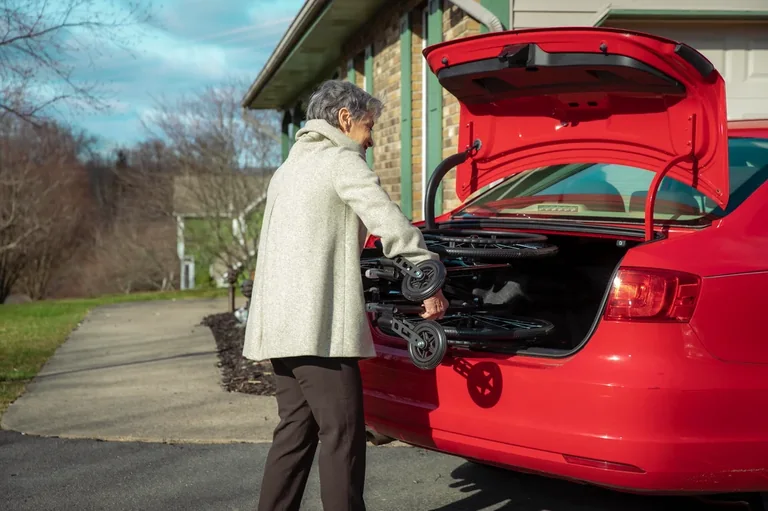
- A rollator that converts to a transport chair. The genuine bridge. They walk what they can walk and get pushed the rest, in one object, without declaring a change of category.
- A wheelchair for distance only. Walking indoors, wheeled for the airport, the zoo, the hospital corridor. This is not the end of walking, and framing it as such is why people refuse it.
Why skipping ahead costs walking
Mobility is trained by use. Sit somebody down for the journeys they could have walked and the walking gets harder, which justifies more sitting. The decline is real and it is partly caused by the equipment choice, which is why "we got her a chair to be safe" so often precedes a fast deterioration.
The rule that avoids it: buy for the gap, not for the worst case. Equipment should cover what they cannot currently do and no more. A chair bought two years early does not sit in a cupboard waiting, it gets used, and it takes the walking with it.
The counter-argument, which is also true
Buying too late is a real cost as well, and it is not symmetrical: the price of arriving early is some unnecessary caution, and the price of arriving late is a fall. Somebody who is genuinely unsafe should not be walked through a graded sequence of options for the sake of principle.
And for some conditions the sequence does not apply at all. Where a clinician has advised a chair, or where the change is rapid, staged adaptation is the wrong model and the advice you have already been given is better than this page.
General information, not medical advice. If fit, posture, pressure relief or fall risk is part of your decision, speak to an occupational therapist.