
Buying guide
Should someone with dementia use a rollator?
Often no: a rollator needs brakes locked before sitting, and forgetting that step turns a mobility aid into a fall risk.
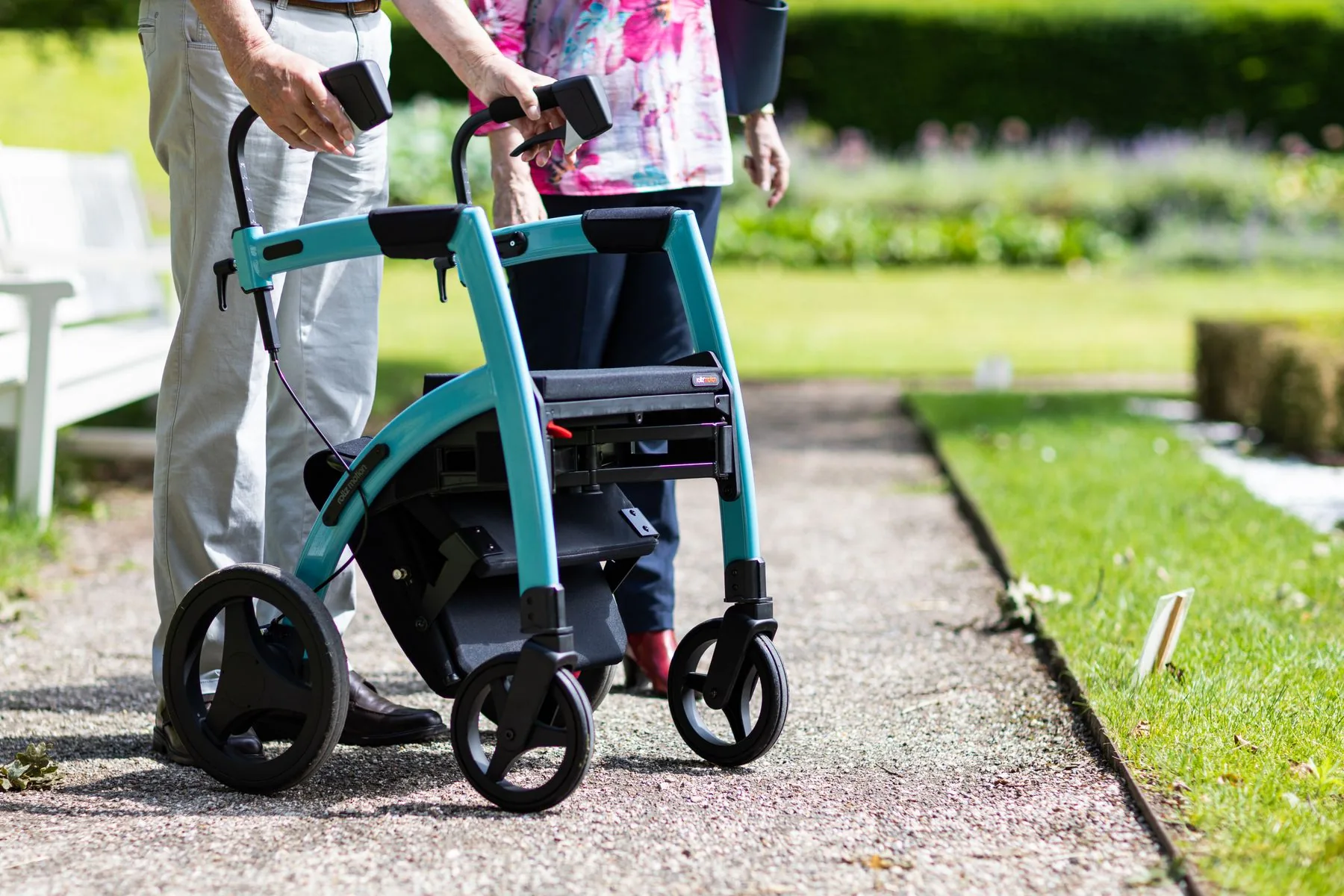
Start with the question underneath the question
People rarely ask this because they are curious about equipment. They ask because someone has stumbled, or has started holding the furniture, or has come home from hospital moving differently. The useful question is not "is a rollator safe for someone with dementia", because dementia is not one thing and neither is a rollator. The useful question is: what does this particular rollator ask of this particular person, every single time they use it, and can they meet that ask without being reminded?
That is a question about the person in front of you. It is not answered by a diagnosis, a stage, or a score.
What a rollator actually asks
A four wheeled rollator is a rolling object. It moves when pushed and keeps moving unless it is stopped. Using one correctly means doing several things reliably:
- Keeping it close, rather than pushing it out ahead and leaning forward to reach it.
- Applying both brakes before turning and sitting on the seat, every time, without being prompted.
- Judging width when going through doorways and turning in tight spaces.
- Remembering it exists, and where it is, when standing up in an unfamiliar room or at night.
None of that is difficult in isolation. All of it depends on a habit holding steady. Where a habit is forming more slowly than it once did, or is not holding at all, the same object shifts from a support to something that can roll away at the worst moment.
When it usually works
A rollator is often a good choice earlier on, when someone still learns and retains new routines, and it works better the earlier it is introduced. A frame that arrives while it can still become automatic tends to stay useful for longer than one that arrives after a fall, when the person is sore, frightened, and being asked to learn something new at the hardest possible moment.
It also works well when someone is genuinely walking alongside them: on outings, at appointments, in the garden. Supervised use and unsupervised use are two different decisions, and they can have two different answers for the same person on the same day.
When it becomes the wrong tool
The clearest warning sign is the seat. If someone sits down without braking, or has done so once, that is not a lapse to be corrected with a reminder. It is information about what this design will keep asking of them. The same applies if they consistently push the frame too far ahead and walk bent toward it, because that posture makes a fall more likely, not less.
At that point the sensible options are usually a frame that does not roll freely, such as a two wheeled walker that only moves when lifted slightly and stops when weight goes through it, or a standard walking frame with no wheels at all. Neither is a downgrade. They simply ask less.
Where buying something will not help
It is worth saying plainly: a great many falls in dementia are not caused by the absence of a walking aid, and no purchase will address them. If someone is unsteady because their blood pressure drops when they stand, because of a new medication, because of an infection, because their vision has changed, or because they get up disorientated at night, then a rollator does nothing about any of that. It may add a hazard in a dark hallway.
The same is true of an aid that will not be used. If the frame lives in the hall and the person walks to the bathroom without it, the problem is not the frame. It is the route, the lighting, the grab rails, and whether the aid is where they will meet it. Sorting those out costs less than most equipment and often matters more. We would rather tell you that than sell you something that sits unused in a hallway.
This is a decision you will make more than once
What suits someone this year may be wrong next year, and the point is to notice that in good time rather than after an injury. Reviewing the aid, the route, and the routine together as things change is what we mean by Mobility Adaptation: not one purchase, but keeping someone moving as their circumstances move.
What to measure, and what to ask
- Handle height: stand them in their usual shoes, arms relaxed at their sides, and measure from the floor to the crease of the wrist. Handles should be set to roughly that height, not to the middle of the range.
- Seat height, if a seat matters: measure from the floor to the back of the knee, in shoes.
- The narrowest doorway in the home, and the turning space in the bathroom. Measure the tightest point, not the front door.
- Thresholds, steps and curbs on the routes actually walked, including the one to the car.
- Weight, if anyone has to lift it into a trunk or up a step.
- Ask a physiotherapist or occupational therapist to watch them use it, ideally at home rather than in a clinic.
- Ask, after two weeks: are they braking before sitting without being told? Answer honestly, because that one answer decides more than any specification does.
General information, not medical advice. If fit, posture, pressure relief or fall risk is part of your decision, speak to an occupational therapist.