
Traveling as mobility changes
The trip usually stops before the ability does, and it stops over logistics that can be solved.
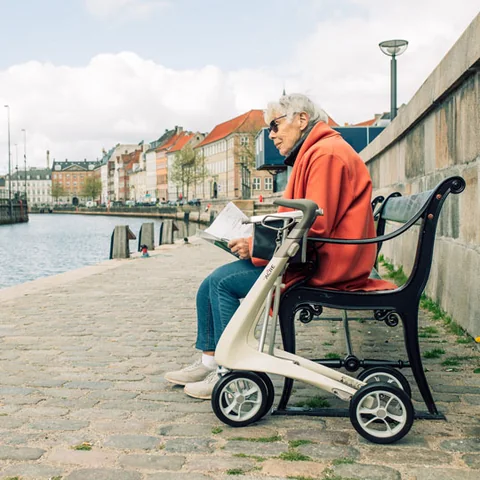
Travel is often the first thing to go and one of the last things that genuinely has to. People stop because of a specific unsolved problem, usually the airport, the walking between things, or not knowing whether there will be anywhere to sit. Each of those is a logistics question rather than a capability one.
The three that actually stop people
- Airport distances. A terminal can be well over a mile of walking, most of it without seating. This is the most common single reason a person who is fine at home decides they can no longer fly, and it is entirely solvable: airport assistance is free, it must be requested in advance, and using it does not require any equipment or any diagnosis.
- The unknown day. Not knowing how far the walking is, or whether there is somewhere to sit, produces the same result as not being able to do it. A seat you are carrying with you removes the uncertainty.
- Getting the equipment there. Weight and folded size decide whether a rollator or chair actually travels, which is why the travel version of a device is usually a different product from the home one.
Practical points worth knowing
Mobility equipment generally travels free on airlines and does not count against a baggage allowance, and a chair or rollator can usually be used to the aircraft door and returned there. Battery rules for powered equipment are strict and vary, so that is worth confirming with the airline directly rather than assuming.
Two devices is a legitimate answer. The one that lives at home and the one that travels have different jobs, and trying to buy a single item that does both well is how people end up with something that does neither.
Why this matters more than it looks
Travel is where the argument for this whole approach is clearest. The point is not equipment. The point is that somebody keeps going to the places that make their life theirs, and the adaptation exists to protect that rather than to manage a decline.
Where the honest answer is no
Some trips genuinely stop being sensible, and pretending otherwise is not kind. Long haul with a condition that is not stable, remote destinations without reachable medical care, and itineraries built around walking that is no longer available are all cases where the better answer is a different trip rather than more equipment. A shorter journey done well beats a long one endured.
General information, not medical advice. If fit, posture, pressure relief or fall risk is part of your decision, speak to an occupational therapist.