
Mobility Adaptation
The questions that decide it.
Two kinds of question. What changes as somebody's mobility changes, and which specific thing to buy when it does. The first set does not end at a product, because often the honest answer is not one. The second always does, because a buying guide that ends at a newsletter was never a guide.
 When a cane is no longer enough
The signs that one point of contact has stopped being sufficient, and why the next step is usually taken about a year too late.
When a cane is no longer enough
The signs that one point of contact has stopped being sufficient, and why the next step is usually taken about a year too late.
 How do you know it is time to change equipment?
One test that works better than any checklist: has their world got smaller, and did anybody notice when.
How do you know it is time to change equipment?
One test that works better than any checklist: has their world got smaller, and did anybody notice when.
 When someone refuses to use a walker
Refusal is usually a reasonable objection to a real cost. What the objection actually is, and what changes it.
When someone refuses to use a walker
Refusal is usually a reasonable objection to a real cost. What the objection actually is, and what changes it.
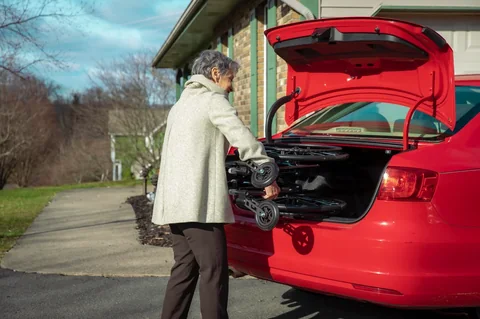 What comes before a wheelchair
The middle steps most people skip, and why going straight to a chair costs walking that could have been kept.
Adapting a home as mobility changes
Most of what keeps somebody moving safely at home costs very little and is not equipment at all.
Mobility after a fall
The injury usually heals. The thing that does not recover on its own is the confidence, and that is what decides the next year.
Traveling as mobility changes
The trip usually stops before the ability does, and it stops over logistics that can be solved.
When mobility equipment is not the answer
The page arguing against what we sell. Five situations where buying something is the wrong move, written by the people selling it.
How much should a wheelchair weigh?
The number that decides whether the chair gets used. What is light, what is liftable, and where the weight actually goes.
Transport chair or standard wheelchair?
Four small wheels or two big ones. This is the most expensive mistake in the category, and it takes one question to avoid.
Choosing a rollator that works outdoors
Wheel size is the whole answer. Why an indoor rollator is unsafe on gravel, and what to buy instead.
Buying mobility equipment for a parent
The purchase is the easy part. What to measure, what to ask, and how to hand the decision back.
What comes before a wheelchair
The middle steps most people skip, and why going straight to a chair costs walking that could have been kept.
Adapting a home as mobility changes
Most of what keeps somebody moving safely at home costs very little and is not equipment at all.
Mobility after a fall
The injury usually heals. The thing that does not recover on its own is the confidence, and that is what decides the next year.
Traveling as mobility changes
The trip usually stops before the ability does, and it stops over logistics that can be solved.
When mobility equipment is not the answer
The page arguing against what we sell. Five situations where buying something is the wrong move, written by the people selling it.
How much should a wheelchair weigh?
The number that decides whether the chair gets used. What is light, what is liftable, and where the weight actually goes.
Transport chair or standard wheelchair?
Four small wheels or two big ones. This is the most expensive mistake in the category, and it takes one question to avoid.
Choosing a rollator that works outdoors
Wheel size is the whole answer. Why an indoor rollator is unsafe on gravel, and what to buy instead.
Buying mobility equipment for a parent
The purchase is the easy part. What to measure, what to ask, and how to hand the decision back.
 Can I take my mobility scooter on a plane?
Usually only if its battery is under 300Wh and it folds small enough, and even then the airline can still refuse it.
Can I take my mobility scooter on a plane?
Usually only if its battery is under 300Wh and it folds small enough, and even then the airline can still refuse it.
 When should you switch from a walking stick to a rollator?
The signs a stick has stopped being enough, and the cases where a rollator is the wrong answer rather than the next step.
What Height Should a Rollator Be? Measure Before You Buy, Not After
Measure floor to wrist crease in your walking shoes, then check that number sits inside the model's handle height range before you buy.
Can I lift a mobility scooter into my car?
Folded weight is not the number that matters: the heaviest single piece, lifted at trunk height by the person who will actually lift it, is.
When should you switch from a walking stick to a rollator?
The signs a stick has stopped being enough, and the cases where a rollator is the wrong answer rather than the next step.
What Height Should a Rollator Be? Measure Before You Buy, Not After
Measure floor to wrist crease in your walking shoes, then check that number sits inside the model's handle height range before you buy.
Can I lift a mobility scooter into my car?
Folded weight is not the number that matters: the heaviest single piece, lifted at trunk height by the person who will actually lift it, is.
 Should I rent or buy a wheelchair?
Renting wins for a short recovery, buying wins when nothing is going back, and the deciding factor is your trajectory, not the weekly price.
How hard is it to push a wheelchair, every day, on your route?
Before you buy an attendant chair, check whether the person doing the pushing can manage the hills, curbs and distance they will actually face.
What seat width do I need for a wheelchair?
Seat width is not the width of the chair, and ordering wider for comfort is the mistake that costs you doorways.
Should I rent or buy a wheelchair?
Renting wins for a short recovery, buying wins when nothing is going back, and the deciding factor is your trajectory, not the weekly price.
How hard is it to push a wheelchair, every day, on your route?
Before you buy an attendant chair, check whether the person doing the pushing can manage the hills, curbs and distance they will actually face.
What seat width do I need for a wheelchair?
Seat width is not the width of the chair, and ordering wider for comfort is the mistake that costs you doorways.
 Do I actually need a wheelchair cushion, or is the chair enough?
Who genuinely needs a pressure cushion, who does not, and why the cushion is never the whole answer.
Can you push someone while they sit on a rollator?
No, and the reason matters: a rollator seat is a rest stop, not a seat for being wheeled, unless the model says otherwise.
Should someone with dementia use a rollator?
Often no: a rollator needs brakes locked before sitting, and forgetting that step turns a mobility aid into a fall risk.
Will a wheelchair fit in my car trunk?
Trunk liters do not answer this: measure the opening, the narrowest point and the loading lip, then check someone can actually lift it in.
Can you use a mobility scooter indoors?
Sometimes, but the number that decides it is your hallway, not the scooter's spec sheet, and for many homes the honest answer is no.
Will a wheelchair fit through my doorway?
Measure the clear opening with the door open, compare it to the chair's overall width, not its seat width, and know when a narrower chair will not solve it.
Can You Use a Rollator on Stairs?
No, and carrying one up or down is a fall risk. Here's what homes with stairs actually need, from a second rollator to stair-specific aids.
Do I actually need a wheelchair cushion, or is the chair enough?
Who genuinely needs a pressure cushion, who does not, and why the cushion is never the whole answer.
Can you push someone while they sit on a rollator?
No, and the reason matters: a rollator seat is a rest stop, not a seat for being wheeled, unless the model says otherwise.
Should someone with dementia use a rollator?
Often no: a rollator needs brakes locked before sitting, and forgetting that step turns a mobility aid into a fall risk.
Will a wheelchair fit in my car trunk?
Trunk liters do not answer this: measure the opening, the narrowest point and the loading lip, then check someone can actually lift it in.
Can you use a mobility scooter indoors?
Sometimes, but the number that decides it is your hallway, not the scooter's spec sheet, and for many homes the honest answer is no.
Will a wheelchair fit through my doorway?
Measure the clear opening with the door open, compare it to the chair's overall width, not its seat width, and know when a narrower chair will not solve it.
Can You Use a Rollator on Stairs?
No, and carrying one up or down is a fall risk. Here's what homes with stairs actually need, from a second rollator to stair-specific aids.