
Buying guide
Can You Use a Rollator on Stairs?
No, and carrying one up or down is a fall risk. Here's what homes with stairs actually need, from a second rollator to stair-specific aids.
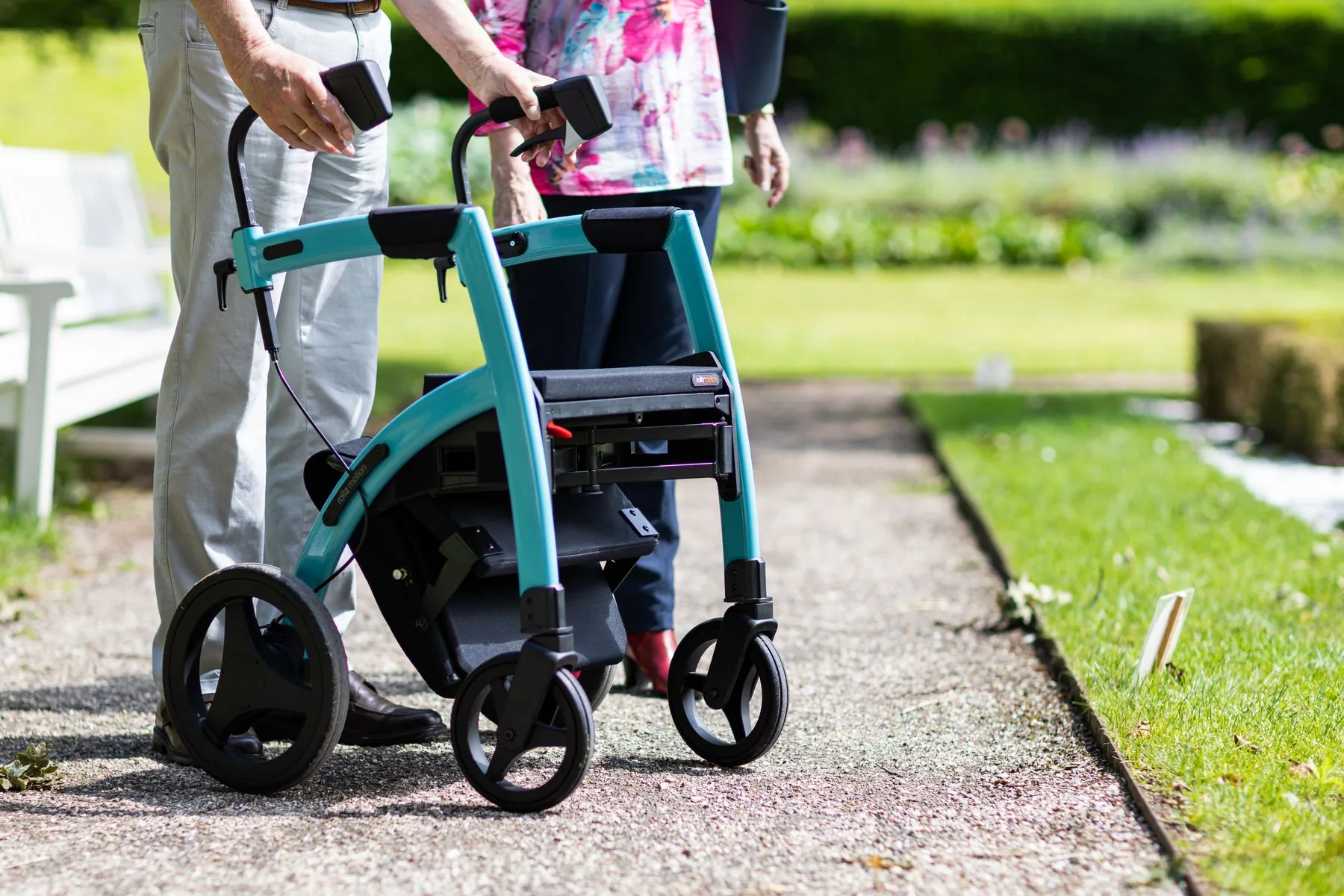
The short answer
No: a rollator is not made for stairs, and you should not try to use one on them. A rollator is built to roll on a continuous surface. It has wheels, hand brakes and often a seat, and every one of those features assumes the ground stays level. On a flight of stairs the wheels have nothing to grip, the brakes cannot hold the frame against a step edge, and the user ends up carrying or balancing a frame at the very moment they most need a hand free for the rail.
Carrying a folded rollator up or down stairs is a common habit, and it is also a risky one. You need one hand for the rail and the other is busy with the frame, so your balance depends on a narrow step and nothing else.
Why this question matters more than the product
When someone asks whether a rollator works on stairs, the real question is usually bigger: how will this person get around the whole home, not just the flat parts of it? That is a question about mobility adaptation, the ongoing process of changing how a person moves as their needs change so they can stay active, involved and independent. A rollator is one tool in that process. Stairs need a different tool, a different plan, or both.
This is often where an adult child researching on a parent's behalf can help most: not by finding a cleverer rollator, but by looking at how the home is actually used day to day.
Where a better rollator will not help
The honest answer is that if the stairs are the main difficulty, no rollator, however well made, will solve it. Lighter frames, bigger wheels and better brakes improve walking on level ground and outdoors. None of them makes a staircase safe to climb with a frame in hand.
If you find yourself comparing models in the hope that one will "manage the stairs," stop and put the effort elsewhere. The solutions are in the home and in the routine, not in the shopping cart.
What people actually do about stairs
- A rollator on each floor. Many households keep one frame downstairs and one upstairs, so neither has to travel. The person uses the handrail on the stairs and picks up the waiting rollator at the top or bottom.
- Handrails on both sides. A second rail lets a person hold on with both hands and swap sides going up and down, and it costs far less than most equipment.
- Rethinking which rooms are used. Moving a bedroom, or adding a downstairs toilet, can mean the stairs are climbed once a day instead of ten times.
- A stairlift or other installed equipment. For some homes and some people, this is the right step. It is a significant decision and worth a proper assessment before committing.
- Strength and balance work. A physical therapist can sometimes improve how confidently a person manages stairs. That is something a purchase cannot do.
Single steps and curbs are a different matter
A single step, a doorway threshold or a curb is not the same as a staircase. Some rollators have a foot lever at the back, sometimes called a tipping aid, that helps the user lift the front wheels onto a low step while keeping both hands on the handles. If the person regularly meets curbs or a front door step, it is worth checking whether a model has this feature and practicing with it somewhere safe first. Larger front wheels also tend to handle uneven ground and small lips more easily than small ones.
Even so, a step that feels awkward every single day may be better fixed with a small ramp or a rail by the door than with technique.
Get an assessment before you buy
An occupational therapist can visit the home and look at the stairs, the entrances and the routes between rooms. They will see things that are easy to miss when you live with them, and their advice covers the person and the house, not just the equipment. If you are planning for a parent, ask whether you can be there for the visit.
For a wider view of how needs change over time and how to plan for them, see our guide to Mobility Adaptation.
What to measure and what to ask
- Count the stairs between floors and note whether there is a landing partway up.
- Measure the space at the top and bottom of the stairs: is there room to park a rollator out of the walking path?
- Check the handrails: is there one on each side, and does it run the full length of the flight?
- Measure every step and threshold at the entrances, including the front and back doors.
- List the rooms used upstairs and how often each day.
- Ask the person directly: which parts of the home do they now avoid, and why?
- Ask an occupational therapist: would a second rollator, extra rails, or a change in how rooms are used meet the need before anything larger is considered?
General information, not medical advice. If fit, posture, pressure relief or fall risk is part of your decision, speak to an occupational therapist.