
Buying guide
Can you push someone while they sit on a rollator?
No, and the reason matters: a rollator seat is a rest stop, not a seat for being wheeled, unless the model says otherwise.
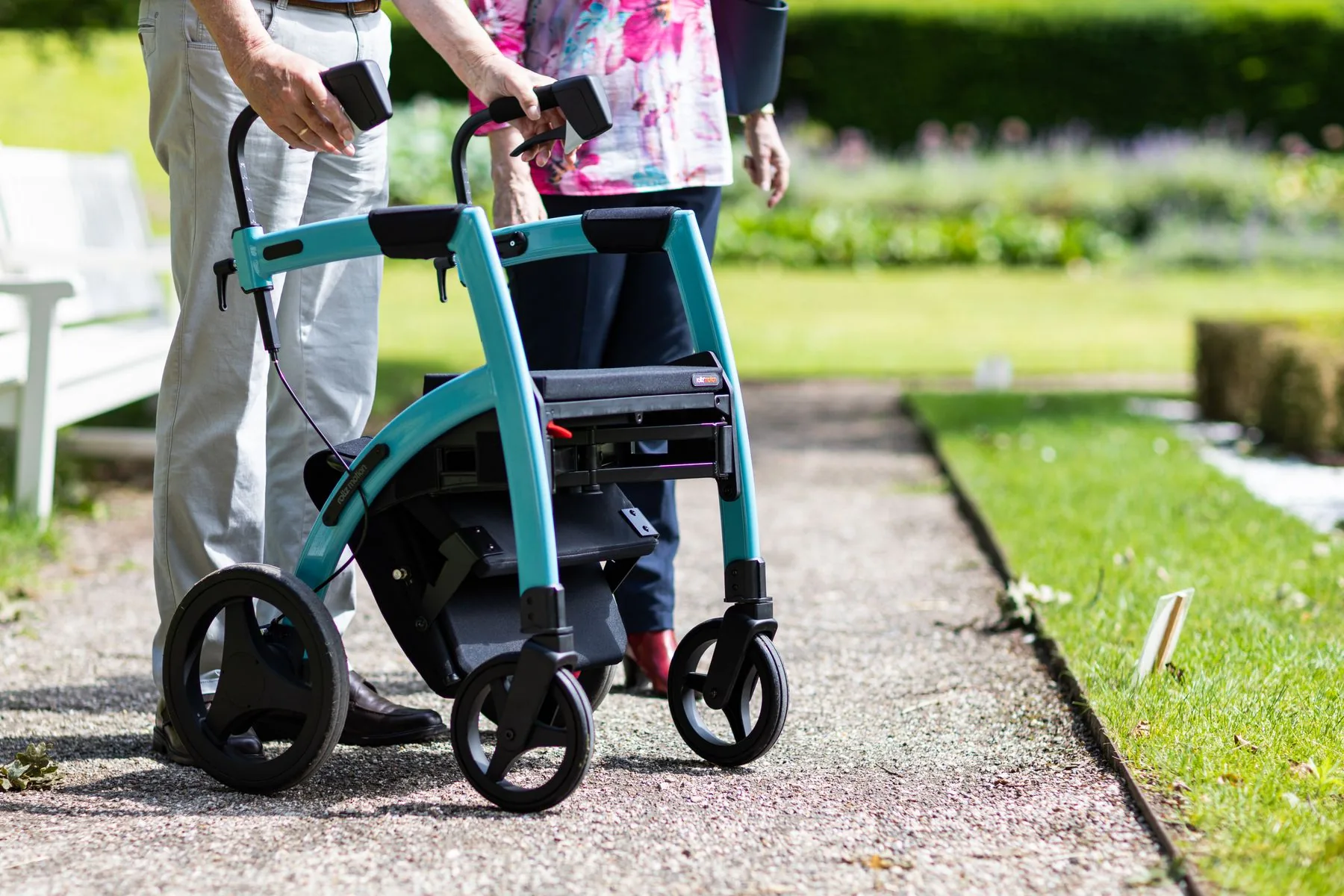
The short answer
No, not safely. A standard rollator is designed to be pushed by the person using it, while they walk behind it. It is not designed to carry a seated passenger while someone else propels it. The seat exists for resting, stationary, with both brakes locked.
That is the honest answer, and it is worth saying plainly, because this question almost always comes from a real and reasonable moment: someone got tired halfway around, and the person with them wanted to help.
Why a standard rollator is not built for it
Four things are missing, and each one matters on its own:
- Nowhere to put the feet. There are no footrests. Feet either drag along the ground, which can catch and pull a person forward out of the seat, or they are held up, which is tiring and unstable.
- Brakes made for a walking user. Rollator brakes are loop levers on the handles, sized and positioned for someone standing upright and slowing themselves. They are not attendant brakes, and they are not designed to hold a moving load on a slope.
- A seat with no lateral support. Most rollator seats are shallow, flat and often a soft sling, with a strap or light bar as a back. That is fine for two minutes at rest. It gives a person very little to stay put in when the device is moving and turning.
- No curb or threshold provision. Wheelchairs have a tipping lever so an attendant can lift the front wheels over a lip. Rollators have none, and small front casters stop dead at a raised edge.
There is also a rating question. On devices that are genuinely built for both jobs, the manufacturer often gives two different weight limits: one for the person walking with it, and a lower one for the person being pushed while seated. A rollator that only publishes a single walking figure is telling you what it was tested to do.
What the situation is actually telling you
If someone needs to be pushed even occasionally, that is not a failure and it is not a decline. It is information. It usually means the distance they can manage comfortably has changed, or that a specific type of outing, a hospital corridor, an airport, a garden center, a wedding, sits well beyond it.
This is the ordinary shape of Mobility Adaptation: the aim is not to keep one device working past its design, it is to change how someone moves so they keep going to the things they want to go to.
The device that does do this job
The category you want is a rollator transport chair, sometimes sold as a two in one rollator and transport chair. It converts: used one way it is a walking frame with a rest seat, used the other way the backrest and footrests are set up so a person can sit forward facing and be pushed by someone standing behind.
They are a genuine compromise rather than a free upgrade. Compared with a plain rollator they are heavier to lift into a car trunk and often bulkier folded. Compared with a proper transport chair they are usually less comfortable over a long push. If ninety per cent of the use is walking and ten per cent is being pushed, that trade is often worth making. If the ratio is the other way around, it is probably not.
When buying something will not fix it
Sometimes the honest answer is that no purchase helps here.
If the reason someone needs pushing is unexplained new weakness, breathlessness, dizziness, a fall, or a change over weeks rather than years, a device is the wrong response and a clinical assessment is the right one. Buying a chair in that situation can quietly delay the thing that would actually have made a difference.
If the pushing is needed for one specific trip a year, borrowing is often better than owning. Many airports, large hospitals, museums and garden centers lend wheelchairs free at the door, and most people are surprised how many do.
And if the person being pushed does not want to be pushed, no equipment resolves that. It is a conversation, not a product, and it usually goes better when it is framed around what they want to be able to attend.
What to measure and what to ask
- Seated weight limit, stated separately. Ask for the transport mode figure specifically, not the walking figure.
- Seat width, measured on the person. Sit them on a firm chair and measure across the widest point of the hips, then compare to the stated seat width.
- Lower leg length. Floor to the back of the knee, seated, to check the footrests will actually reach.
- Folded size and weight. Measure the trunk opening and the trunk floor before you buy. Then ask who lifts it, and whether they can.
- The narrowest doorway at home, and the tightest turn on the route you use most.
- Are there attendant brakes? If the only brakes are the handle loops, ask directly how the device is held on a slope with someone sitting in it.
- Handle height for the person pushing, not just for the person walking. A push handle set for a short user is punishing for a tall one.
General information, not medical advice. If fit, posture, pressure relief or fall risk is part of your decision, speak to an occupational therapist.